The bad sales hire gets the blame. The unproven motion does the damage.
Before you hire someone to run your sales motion, make sure there's a motion to run.
Michael McAtavey
Founder, Congruity B2B · July 1, 2026 · 5 min read
Founders obsess over hiring the first salesperson. Few stop to ask the more important question: is there a repeatable motion for that person to run?
It's easy to miss, because the hire feels like the decision and the motion feels like a detail. The conversation everyone's having right now is about bad sales hires. The six-figure rep who never ramped. The VP who lasted three quarters. The SDR you coached for six months before you admitted it wasn't working. If you've run founder-led sales, you've lived at least one of those.
So the advice making the rounds is "hire better." Screen harder, onboard tighter, write a real scorecard. All fair. But it's aimed at the wrong risk.
The bad hire is the failure you can see. The expensive one is quieter: a perfectly good rep running a motion nobody validated, missing for a year before anyone can say why.
You're hiring one person to do four jobs
Look at what you're actually asking a first sales hire to do at a founder-led company. Not just close. Figure out who really buys. Figure out which message lands. Figure out whether the buyer's reachable by email, by LinkedIn, or only through a warm intro.
That's four jobs in one seat: researcher, marketer, salesperson, and product strategist. Then you judge them on revenue. You're handing someone an open research question and a quota in the same breath, and the meter starts the day they sign.
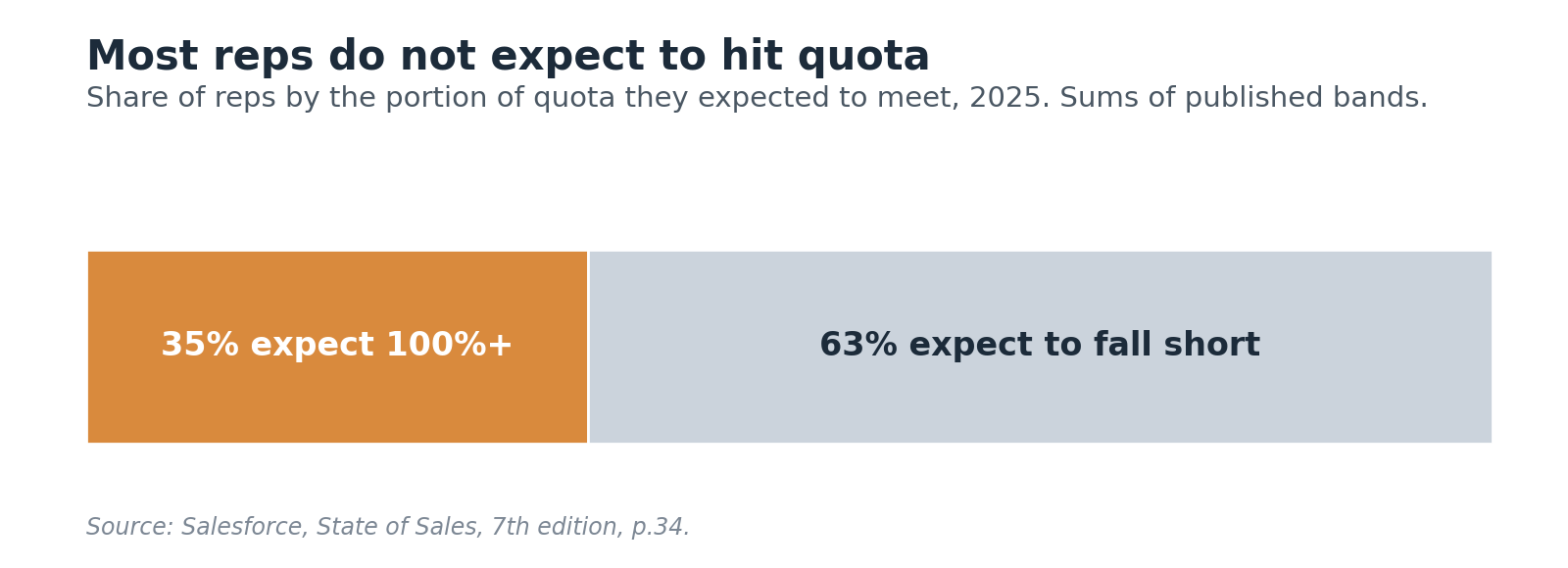
The numbers say how little confidence there is in the outcome. In Salesforce's most recent State of Sales survey, 63% of reps expected to finish under quota.
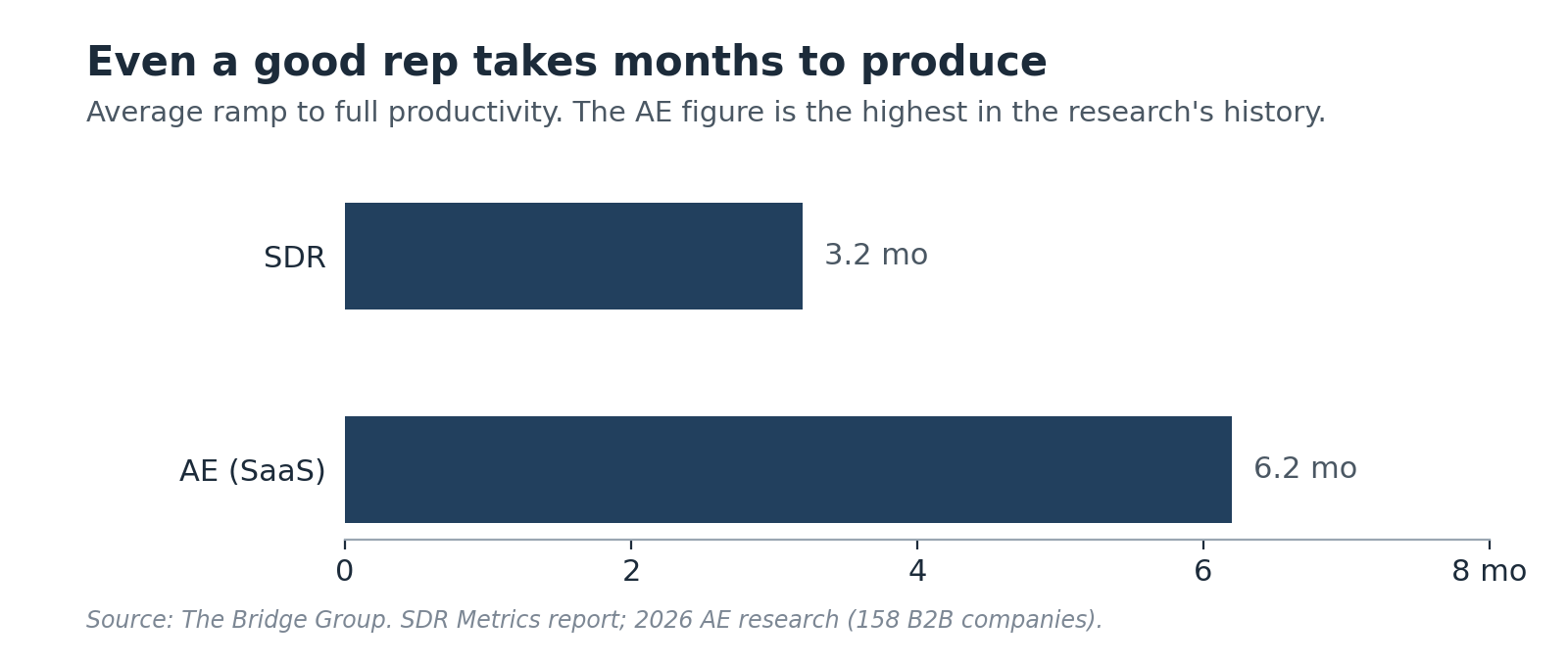
And even a good hire produces nothing for months. New SDRs average 3.2 months to ramp. New AEs average 6.2 months, the longest ramp The Bridge Group has recorded in ten editions of its research.
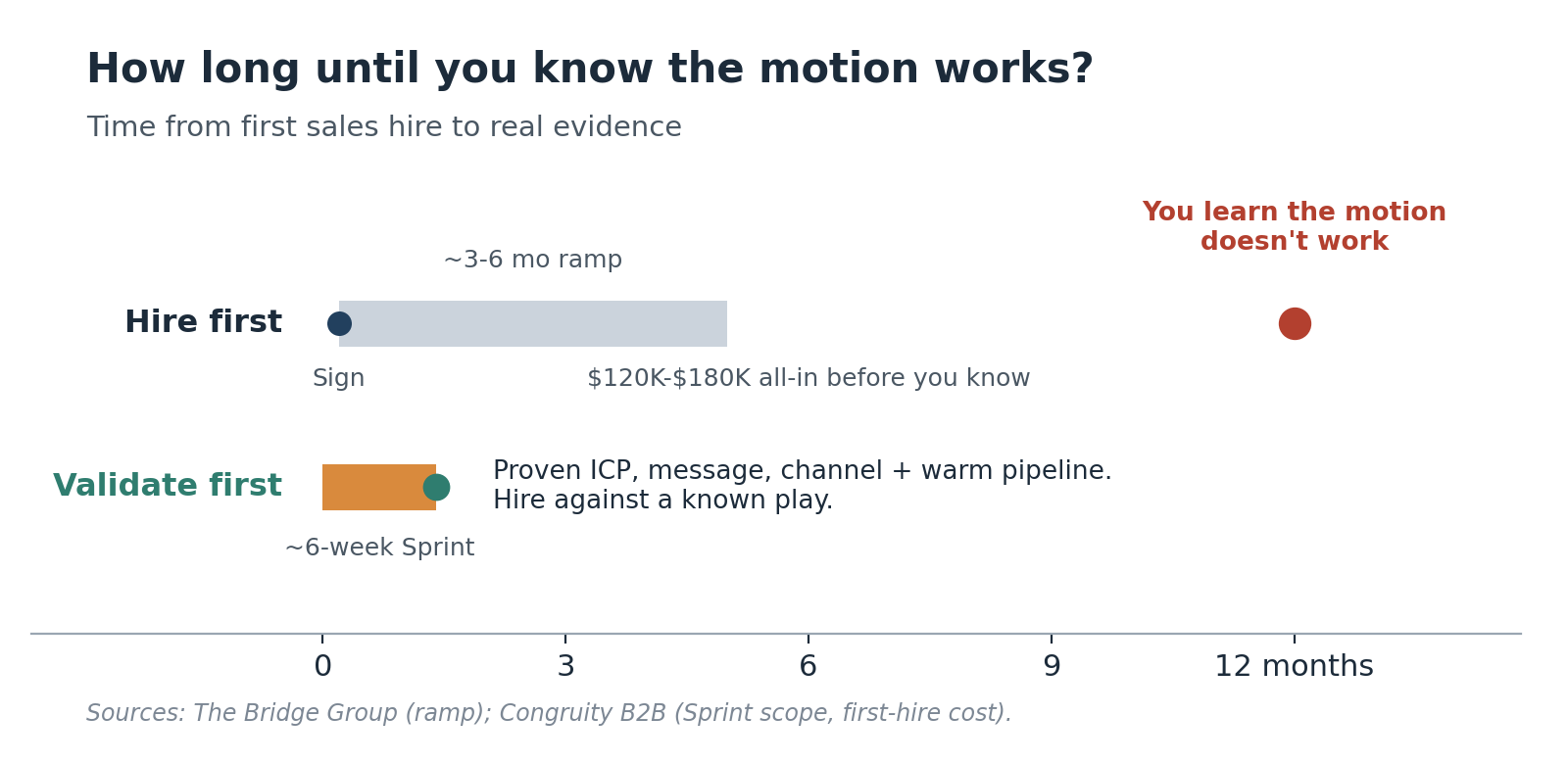
Stack it up: months to ramp, a year to read the results, and long odds that the motion under them was ever real. You don't find out you bet wrong until the cash and the calendar are already gone. And the cleanup isn't cheap. Replacing one failed rep was pegged near $97,000 over a decade ago (DePaul Center for Sales Leadership), and a first sales hire runs $120K to $180K all-in. The clock is short, too: the average VP of Sales lasts about 19 months (Gong), often less than the time it takes to prove the motion was the problem.
Great reps don't invent your motion. They execute it.
Here's the part the "hire better" crowd skips. A great rep can't out-execute a motion that doesn't work. They amplify whatever system you give them. If the ICP's off, sharper discovery won't save it. If the message misses, more dials won't fix it. Hand a strong rep a broken motion and they'll burn through your leads faster. Better execution doesn't rescue a bad motion. It accelerates it.
Which is why the framing matters. You don't have a sales problem. You have an unproven motion. When pipeline's thin, the reflex is to add a person, but the gap usually isn't effort. It's evidence. You can name a target market. You probably can't yet name the segment that actually replies, or the trigger that makes them reply now. You've got a pitch. You don't have proof that this message beats that one, or that the channel you're leaning on is the one your buyer actually reads.
And there's a reason it stays unproven. Outbound's the one thing only you can decide to do, and the one thing nobody's waiting on today. A customer escalates. A board doc's due. A live deal needs you on the call. So prospecting slides to next week, every week. The motion never gets tested, and your first hire inherits the guesswork. Hiring doesn't clear the guesswork. It just puts a salary on it.
Prove the motion before you put it on the P&L
The fix is boring, and it works: get evidence before you get headcount. Run the motion as a contained experiment first. A few weeks of real sends to real buyers, set up so you're testing actual variables, which segment, which message, which channel, and scored against real replies instead of vibes.
You're not building a sales team in those weeks. You're answering three questions before anyone's hired against them. Who responds. What lands. Where they're reachable. Nail those, and your first hire walks into a known motion instead of a blank page.
That's the idea behind the GTM Validation Sprint we run at Congruity: prove the motion before you hire around it. Six weeks, fixed scope, in market. You walk away with four things you keep, a validated ICP built from real responses, a report scoring the message-and-channel combinations you actually ran, the warm pipeline those tests kicked up, and an operating playbook your next hire (or you) can run from day one. The deliverables aren't really the point. The point is you learn what works in weeks, for a fraction of one quarter of a VP Sales salary, instead of paying a hire to learn it over their first two quarters.
What good looks like
You open the rec with the answer already in hand. The job post names the segment that replies, not "help us find our ICP." The first call your new rep makes is into a list that already worked, with a message that already pulled responses. They're ramping against a known motion, not a hypothesis. You're paying them to scale something that works, which is the only thing a salesperson is actually good value for.
Watch-outs
Validation isn't a substitute for hiring. It's the step before it. You still need a closer. You just stop asking them to moonlight as your researcher.
It's also not for everyone. If your motion's already proven, your ICP's clear, and your reps are hitting quota, you don't need to validate anything. Go hire. The Sprint's for the team that hasn't earned that confidence yet and is about to spend six figures as if it has.
And don't mistake activity for evidence. A month of unstructured sends isn't a test. If it's not scored against a control, you've got noise, not a read.
The takeaway
"Hire better" is fine advice. It just solves the smaller problem. The wrong person is a setback you can spot and fix in a quarter. The right person running an unproven motion is a year and a few hundred thousand dollars you don't get back.
So before you send that offer, ask yourself one question: am I hiring someone to execute a playbook, or to invent one? If the answer's "invent one," validate the motion first.
If you're looking at a sales rec right now and you're not sure the motion under it is real, that's worth a conversation. Happy to connect whenever works for you.
Updated 4 August 2026. This piece originally cited the 6th edition of Salesforce's State of Sales as showing 84% of reps missing quota. That report measures the share of quota reps expect to meet rather than what they achieved, and the 6th edition is no longer available at its published URL. The body, chart and sources now use the 7th edition's comparable figure. The argument is unchanged.
Sources
Salesforce, State of Sales, 7th edition, page 34: 63% of reps expected to meet less than 100% of quota in 2025, down from 84% the prior year. Both figures are sums of the report's published bands, and the question asks what reps expect to meet rather than what they achieved.
If you're not sure the motion under the rec is proven, that's exactly what a strategy call is for. Bring the rec. We'll pressure-test the motion together.