Four documents your first sales hire should walk into on day one. If you can't produce them, the req can wait.
Michael McAtavey
Founder, Congruity B2B · July 14, 2026 · 6 min read
Here's a test you can run before the req goes up. Write down what your first sales hire will actually find when they log in on day one. Not what you'll cover in onboarding. What exists, in writing, that they can work from.
For most founder-led companies the honest list is short. A CRM with a few hundred contacts of mixed vintage. A pitch deck built for investors. A pricing page. A quota. Everything else lives in your head, which means on day one it doesn't exist.
Two posts ago I argued the real risk in a first sales hire is the motion underneath them, not the person. Last week the argument landed on a directive: hire the process-builder and supply the playbook. Which set up the obvious question: what does that playbook actually contain?
This post is the answer. A validated motion is four documents. Not a strategy, not conviction, not founder intuition. Four documents you can put in a shared drive and hand to a new hire, each one downstream of real buyers doing real things.
Why documents, not answers
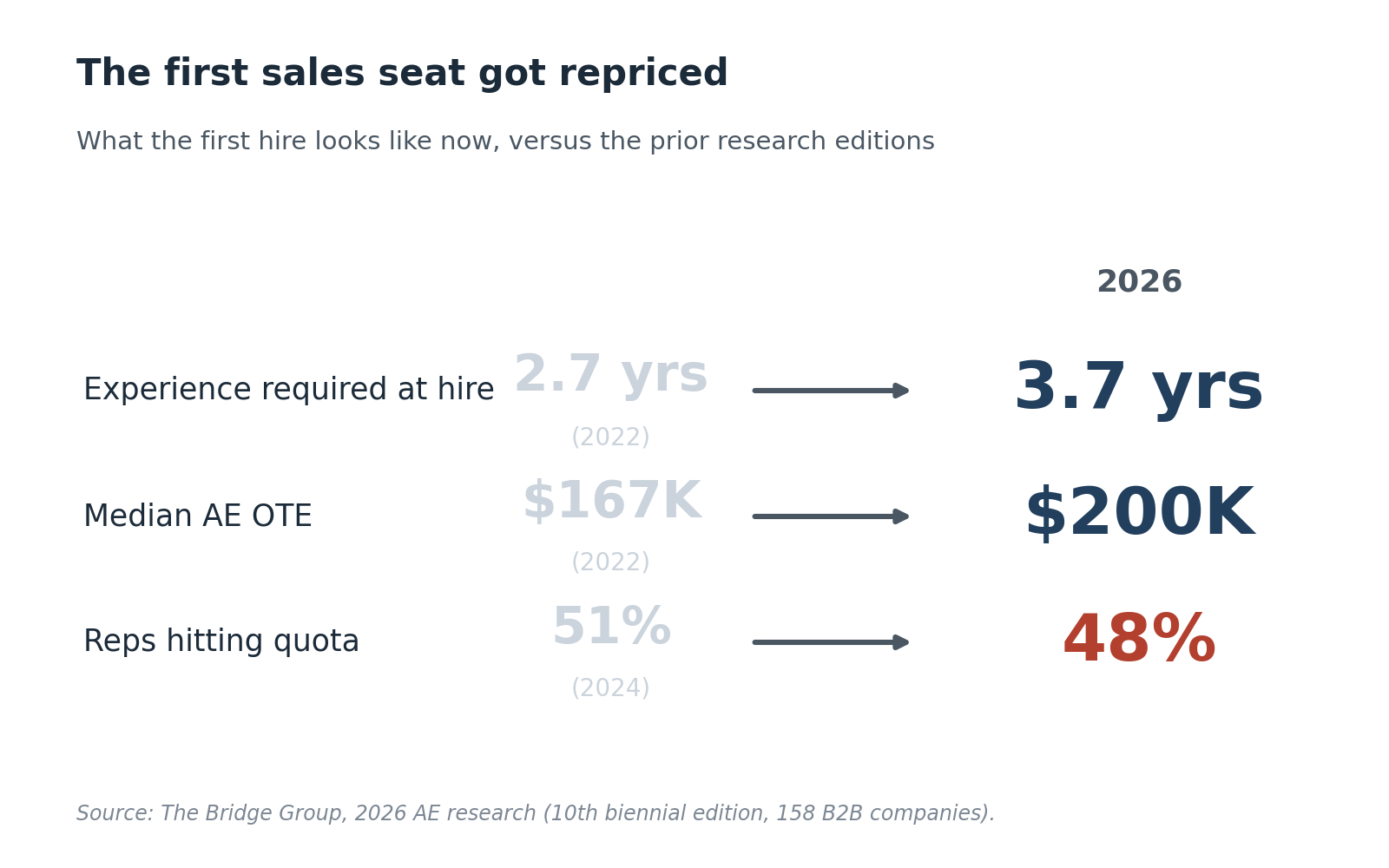
The stakes make the standard worth holding, and they moved this year. The Bridge Group's 2026 AE research (10th biennial edition, 158 B2B companies) puts the experience now required at hire at 3.7 years, up from 2.7 in 2022, median AE on-target earnings at $200K, up from $167K in 2022, and quota attainment at 48%, down from 51% in 2024. The seat got more senior, more expensive, and less likely to hit the number, and it still takes an average of 6.2 months to ramp, the highest in the research's history. A first sales hire runs $120K to $180K all-in. Every document missing on day one gets produced during that ramp, by the most expensive and least equipped researcher available: a commissioned salesperson working without evidence, against a clock you're paying for.
The market already reached for the other lever. Revenue leaders now rank raising the productivity of the team they have as the number one growth strategy for 2026, up from fourth the year before (Gong Labs, State of Revenue AI 2026, 3,048 revenue leaders). More output per head, before more heads. And a small team gets more output per head from a motion that repeats, which is what these four documents describe.
A document, as I mean it here, has two properties. It's written down, and it's downstream of a real buyer's behavior. Opinions don't qualify. Strategy decks don't qualify. Replies qualify.
Document 1: A validated ICP
Not a persona deck, and not a TAM slide. A validated ICP is a narrow, named segment plus the evidence that earned it the name: companies of this type, this size, with this trigger, replied when contacted about this problem.
The test: can you define the segment in one sentence and show the replies behind it? "B2B logistics software, 20 to 80 employees, first year after a seed round" is a segment. "Mid-market supply chain leaders" is a wish.
Document 2: The message that pulled replies
Not the brand messaging doc. The actual outbound copy, with results attached: the opening line that got responses, the angle that pulled a meeting, and, just as valuable, the three versions that died. The dead versions keep your hire from rediscovering failure at full salary.
The test: could your hire send it tomorrow, verbatim, and expect roughly the result you got? If the answer is "well, it depends who sends it," you have a founder-brand effect, not a message. Worth knowing before you hire.
Document 3: Channel math
Not "we do email and LinkedIn." The arithmetic of the motion: which channel actually reached this buyer, how many contacts the segment holds, and what reply rate the proven message pulls there.
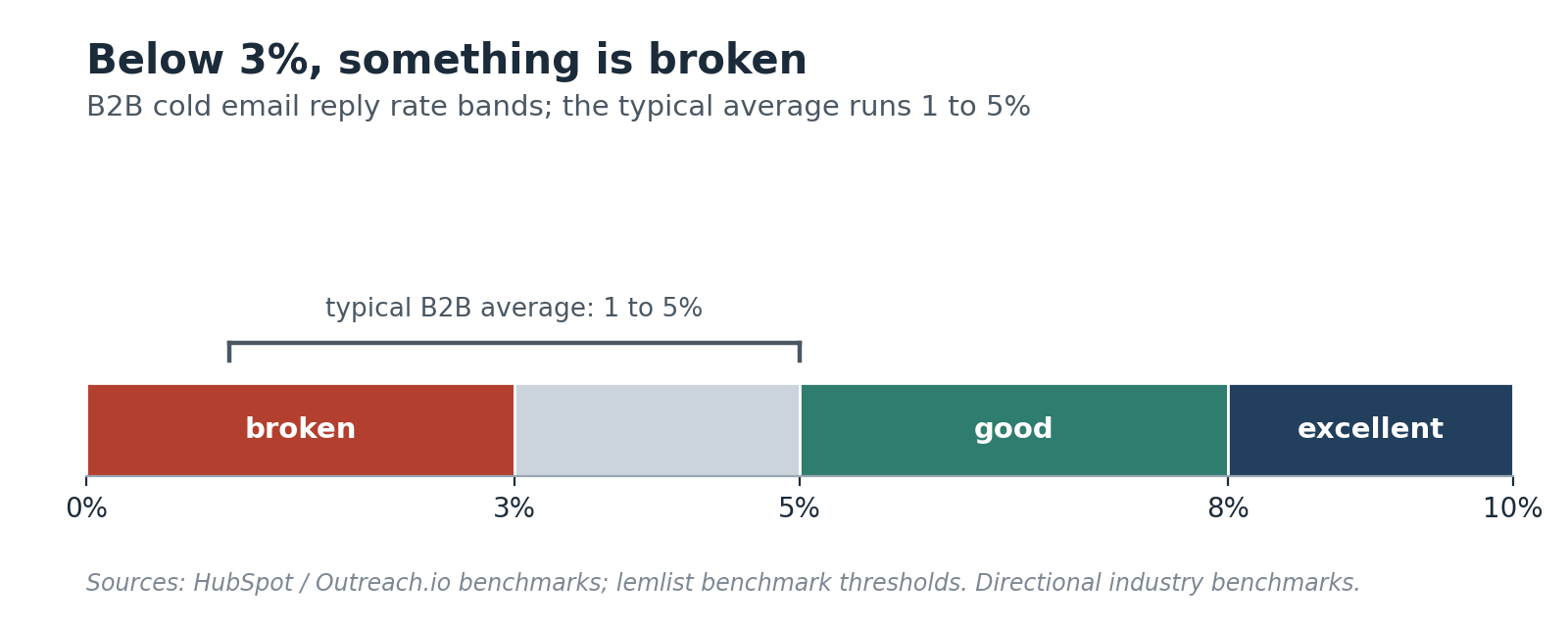
For calibration, typical B2B cold email averages 1 to 5% replies per HubSpot and Outreach benchmarks, and lemlist's operating thresholds treat below 3% as broken, above 5% as good, above 8% as excellent. Directional numbers, not a controlled study. But they're enough to tell whether your motion cleared a bar or you're about to staff a guess.
The math matters because it converts a pipeline goal into an activity plan. A 4% reply rate against a 1,500-contact segment is roughly 60 replies. That's arithmetic, not a benchmark, and you can only do it if you know your rate.
The test: given a replies target for the quarter, can you compute the sends, and does the segment hold enough contacts to support them?
Document 4: The written playbook
Not a 40-page strategy document nobody will open. The playbook is the other three documents bound into an operating document: the segment definition, the sequences verbatim, the objections that actually came up with the responses that worked, qualification criteria, and the weekly operating rhythm. Short enough to be used. Specific enough to be followed.
The test, and it's the test for the whole system: could a competent rep run week one from the documents alone, without interviewing you?
What good looks like
Day one, your hire reads in the morning and sends in the afternoon: the proven sequences, to the next slice of the validated segment. Week one looks like the last week of the experiment that produced the documents, because it's the same motion with a new operator. Ramp is still real. Product knowledge and deal craft take time. But the months usually burned figuring out who buys and what to say to them are already paid for.
Not coincidentally, this is the shape of what a GTM Validation Sprint hands over at the end: the four documents, proven against real buyers, in three to six weeks. But the standard matters more than who runs it. Build them yourself if you have the cycles. Just don't let a hire start without them.
What to watch out for
You can fake all four in an afternoon. Written from your head instead of downstream of real sends, they're fiction with formatting. A document is only a document if a real buyer's reply sits underneath it.
Evidence expires. A validated ICP from eighteen months ago is a hypothesis again. If the product or the market has moved since the evidence was collected, re-run the test before hiring against old receipts.
Volume isn't validation. Ten replies from 5,000 scattershot sends is a 0.2% reply rate, which the benchmarks above would call broken twice over. The rate carries the signal, not the count.
Documents don't replace management. A playbook handed over isn't a playbook followed. You'll still inspect the numbers weekly, and you'll still be in the closing conversations for a while. The documents move prospecting onto rails. They don't outsource the judgment.
The takeaway
If you can produce the four documents, hire. The seat is an execution job, and execution is a skill you can screen for. If you can't, the req isn't wrong. It's early. The evidence has to come from somewhere, and every way of getting it costs less than finding out at month six that the motion was a guess.
There's one serious objection to all of this: maybe a good hire doesn't need the documents. Maybe they just figure it out. That argument deserves a real answer instead of a strawman, and it gets one in the next post.
The Bridge Group, 2026 AE Models, Motions, & Metrics (10th edition, 158 B2B companies): experience required at hire 3.7 years (up from 2.7 in 2022), median AE OTE $200K (up from $167K in 2022), quota attainment 48% (down from 51% in 2024), and AE ramp 6.2 months, the highest in the research's history.
Gong Labs, State of Revenue AI 2026 (3,048 revenue leaders): raising the productivity of existing teams ranks as the number one growth strategy for 2026, up from fourth the year before.
HubSpot and Outreach cold email benchmarks: typical B2B reply rates of 1 to 5%. Directional, not a controlled study.
Congruity B2B, GTM Validation Sprint: first-hire cost ($120K to $180K all-in) and Sprint scope (three to six weeks).
Can you produce the four documents?
If the honest answer is not yet, that's the conversation to have before the req goes up. Bring what you have. We'll pressure-test the motion under it together.