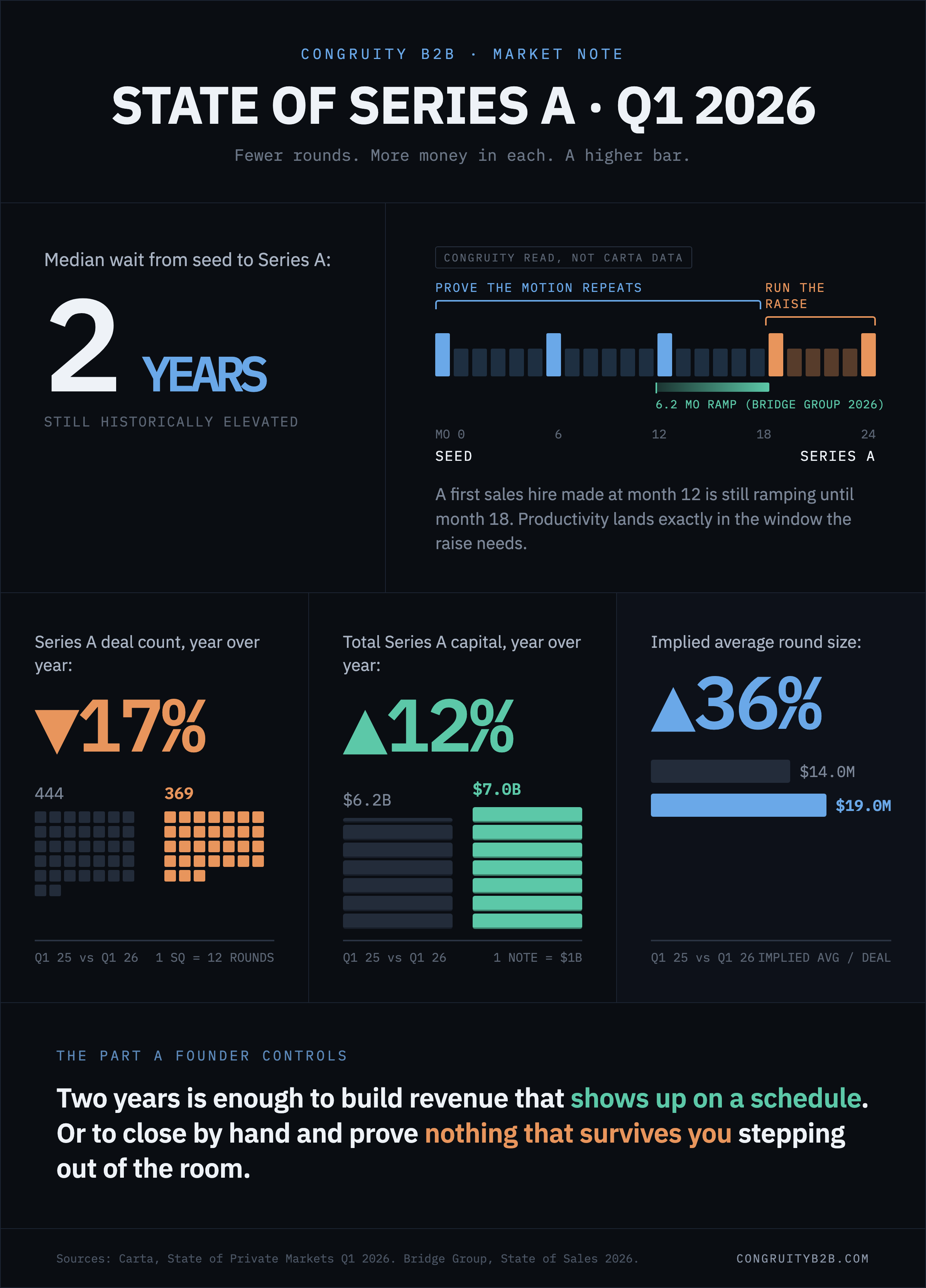
The window is two years. A first sales hire needs six months of it before they produce anything. Most plans only account for the first number.
Michael McAtavey
Founder, Congruity B2B · July 29, 2026 · 6 min read
The plan is familiar enough that most seed-stage founders never bother writing it down. Hire a salesperson somewhere in year two. Get the revenue curve moving. Raise a Series A off the back of it.
It's a reasonable plan. It also has a scheduling problem buried inside it, and that problem doesn't surface until roughly the month it stops being fixable.
Two years, and a narrower door at the end of them
Carta's Q1 2026 data puts the typical gap between a seed round and a Series A at an even two years. Carta calls that historically elevated, while noting that early-stage intervals have started to compress again: companies are moving a little faster at the front of the funnel than they were a year ago.
Two years reads like room to work with, which is exactly why the problem hides.
What's happening at the far end of that window matters more than its length. In Q1 2026 the number of Series A rounds fell 17% year over year, from 444 to 369, while the capital flowing into them rose 12%, from $6.2 billion to $7.0 billion. Divide one into the other and the implied average round grew from about $14.0 million to $19.0 million. Fewer companies are getting through the door, and the ones that do are walking out with meaningfully more. Seed shows the same shape, 21% fewer rounds against 25% more capital. Carta's own phrase for it is that the seed funnel is narrowing.
If you aren't an AI company, one more figure is worth sitting with. Pre-money valuations fell year over year at both seed and Series A, down 6.6% and 7.1%. Carta's read is that outside AI the negotiating environment is tighter than the headline recovery suggests. Put plainly, proof is doing more of the work than story right now.
The second clock
Here's the number that turns all of that from market commentary into something on your calendar.
The Bridge Group's 2026 research puts ramp time for an account executive at 6.2 months. Not time to a first meeting. Time until the person is producing at the level you hired them to produce at. It's the longest figure in the history of that study, and it has been climbing.
Carta and Bridge aren't in conversation with each other. One measures fundraising timelines, the other measures sales onboarding, and they draw on different populations, so the arithmetic that follows is mine rather than a finding either of them published. But you're running both clocks at once whether or not anybody has put them on the same page.
Say you hire your first salesperson at month 12, which is where most seed-stage plans land. Ramp puts them at full productivity somewhere around month 18. The closing stretch before a round belongs to the round itself: the deck, the data room, the diligence, the meetings. So the person you brought in to prove the company can sell without you generates close to zero fully productive quarters before you're sitting in front of investors with that exact question on the table.
Run it backward and it sharpens. For that hire to produce even two clean quarters of evidence, they'd need to start around month six. Six months after a seed round, almost nobody has a motion worth handing to somebody else.
Which means the deadline you're actually working against was never the hire. It's proving the motion early enough that another person's ramp still fits inside the window.
Why the problem stays quiet
Founder-led selling works, and that's precisely what makes this hard to see coming. Deals close. Revenue shows up. The chart points the right way and nothing in it looks like a warning.
They close because you close them. You know the product at a depth no new hire will match for months, your name on a cold email opens doors theirs won't, and you can restructure a deal in the room without asking anyone's permission. None of that transfers. All of it is quietly doing the work you'll later hand to a rep and expect them to do from a standing start, on a shorter clock, while your attention is on the raise.
An investor looking at founder-closed revenue learns something real, which is that you can sell. What they don't learn is whether the company can, and that second question is the one sitting underneath a Series A. It's also the question a first hire usually gets brought in to answer, at the precise moment there's no longer enough runway to answer it.
That's the unproven motion. Not a sales problem and not a people problem. A sequencing problem.
What you want in place before anyone starts
The fix isn't hiring earlier. It's arriving at the hire with the motion already legible.
In practice that means you can name the segment you sell to, down to the job title that actually feels the pain and a rough count of how many of those people exist. It means you have a message that pulled replies from strangers rather than from your network, because a reply to a warm intro tells you about your relationships while a reply to a cold one tells you about your message. It means you know your channel math: how many touches produce a conversation, how many conversations produce a deal, and what that costs you to run. And it means somebody has written down how a deal actually moves, including the objection that surfaces every single time and the answer that gets past it.
None of that requires a salesperson. What it does is make the salesperson interpretable. They show up executing a known motion instead of inventing one, and when something misses you can tell whether the problem is the person or the plan, because only one of those two is new.
That list is the whole scope of the GTM Validation Sprint we run at Congruity: six weeks in market, testing the segment, the message, and the channel math against real buyers before anyone's start date. Run it yourself if you have the cycles. Just don't let the first hire be the one who runs it.
Where this argument doesn't hold
It's worth being clear about the cases where hiring first is the right call.
If leads are arriving on their own faster than you can work them, you have a coverage problem rather than a motion problem, and you should hire a closer. The trap isn't inbound itself. It's assuming inbound will keep pace with a two-year clock and discovering well into the raise that it flattened. The question to put to yourself is whether it compounds on its own, or whether you're the engine behind most of it.
A rep will also teach you things no validation test can reach: how an objection sounds when a real buyer says it out loud, where pricing snags in procurement, why deals stall in legal. That's the strongest argument for hiring early and it deserves to be taken seriously. Its limit is that when the motion underneath the hire is unproven, a miss arrives with two explanations and no clean way to separate them. You lose the months, and you lose the ability to learn anything from having lost them.
One caution on the testing itself. If the replies come because you're the founder, you've validated your credibility rather than your message. Build the test so you can tell those two apart.
Takeaway
You get roughly two years. The last stretch belongs to the raise, and a first sales hire consumes six months of what's left before producing anything you can show anyone.
That arithmetic only works if the motion is proven before the hire rather than discovered through them. So the question worth answering now isn't who to hire, or when. It's what would have to be true at month six for that hire to produce evidence instead of questions.
Carta, State of Private Markets: Q1 2026 (Ashley Neville, published May 29, 2026): the typical seed to Series A period at an even two years, described as historically elevated with early-stage intervals beginning to compress; Series A at $7.0 billion across 369 rounds in Q1 2026 versus $6.2 billion across 444 rounds in Q1 2025 (capital up 12%, deal count down 17%); seed capital up 25% on deal count down 21%, with the note that the seed funnel is narrowing; pre-money valuations down 6.6% at seed and 7.1% at Series A year over year.
The Bridge Group, State of Sales 2026 (10th biennial AE edition, 158 B2B companies): account executive ramp at 6.2 months, the longest in the history of that research.
Implied average round size ($14.0 million to $19.0 million, up about 36%) is calculated from Carta's published capital and deal count, not a figure Carta reports directly. Carta corroborates the direction only.
Carta and The Bridge Group measure different populations and neither study references the other. The month-by-month arithmetic laid over them is my illustration, not a joint finding, and the read on what clears the bar is mine.
What has to be true at month six?
If a first sales hire is on the roadmap before the next round, that's the conversation to have now. Bring the plan. We'll work backward from the raise together.